
I understand the skepticism around assigning deep meaning to a seemingly random cartoon generated by artificial intelligence. But before passing judgment, you have to actually look at the cartoon.
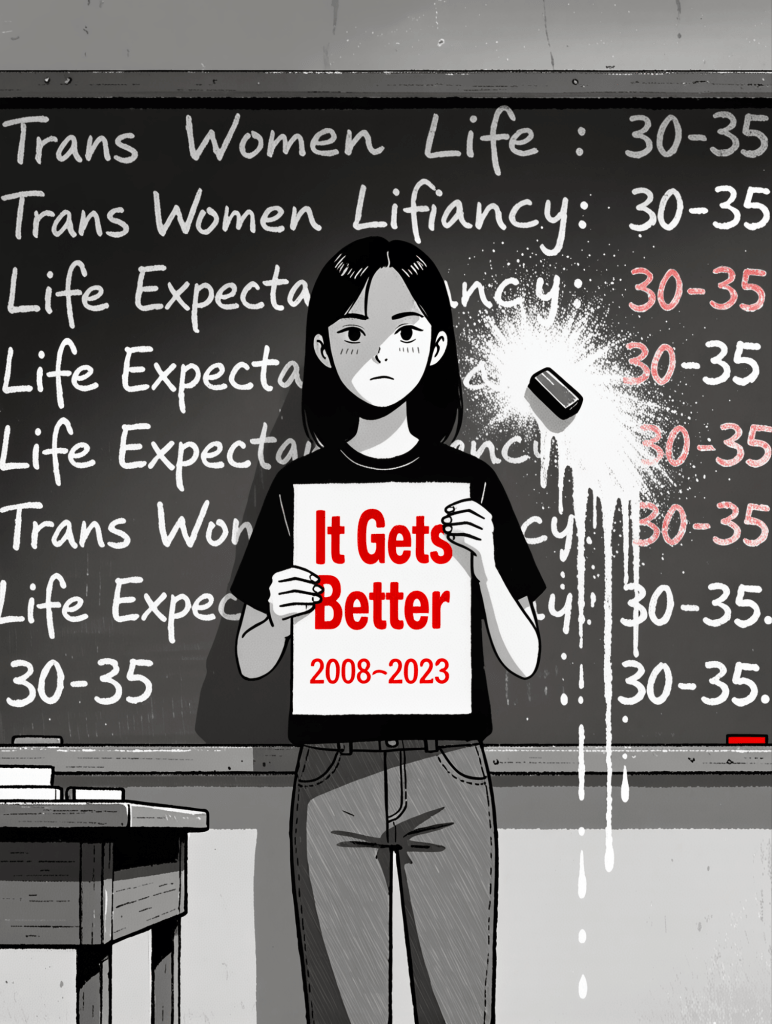
So, what do you see? What does this cartoon tell you?
The first thing that caught my eye was what’s written on the paper the girl is holding. Doesn’t it look like a message from someone who sees both the past and the future?
“It Gets Better” — a perfect sentence, because deep down, we all want to believe it will.
But what about “2008–2023”? That might mean nothing to you, but to me… it means everything.
Especially 2023, a year I will never forget. The year I attempted suicide, was hospitalized in a psychiatric ward, discovered the full extent of my family’s lies and hypocrisy, and was forcibly taken — indirectly but deliberately — to a so-called psychologist who was practically a pedophile and a manipulator. It was the year I realized no promise would ever be kept, and that I had to rebuild my life from zero.

But how did ChatGPT know all of this? The answer is simple: I had written about it before — and used ChatGPT to help me translate my writings into English. It knows many things about me, and it knows when to use them, which makes me wonder:
Is this a message from God… or am I just desperate to assign meaning to everything?
Does it matter? After seeing that cartoon and the way it made me feel — yes, I think it does matter.
For a long time, I’ve been questioning something in my own mind, something I’ve been curious about. And now I’ve connected it to this cartoon: energy. But before we talk about that, we need to finish breaking this image down.
“It Gets Better” was originally the name of a 2010 campaign launched to inspire hope among LGBTQ+ youth. But in this cartoon, the message is used far more ironically.
The text “Trans Women Life Expectancy: 30–35” written behind the girl is disturbing. Why 30 to 35? I couldn’t find any reliable explanation at first. Some words are written in red, others in white — which makes it even more unsettling. Some parts are misspelled or wiped away with messy brush strokes. The smudges, the erasures, the disjointed letters — they all symbolize something: that the promises made through hopeful slogans didn’t work. Trans women are still dying.
> “Words that once promised hope now remain only as memories.”
That, I believe, is the cartoon’s true meaning.
But for me, it represents something much more personal.
“2008–2023” marks the years during which I went through immense pain, questioned everything, and slowly came to understand my trans identity. It’s a timeline of rebirth — of learning to say “I am a woman!” out loud and proudly in front of a mirror. It’s not just about my gender; it’s about every moment of pain I endured, every mask I tore off, every illusion shattered. It’s about the so-called family who betrayed me, the relatives who disgust me, the so-called friends who turned out to be nothing more than parasites — and the truths I had to confront alone.
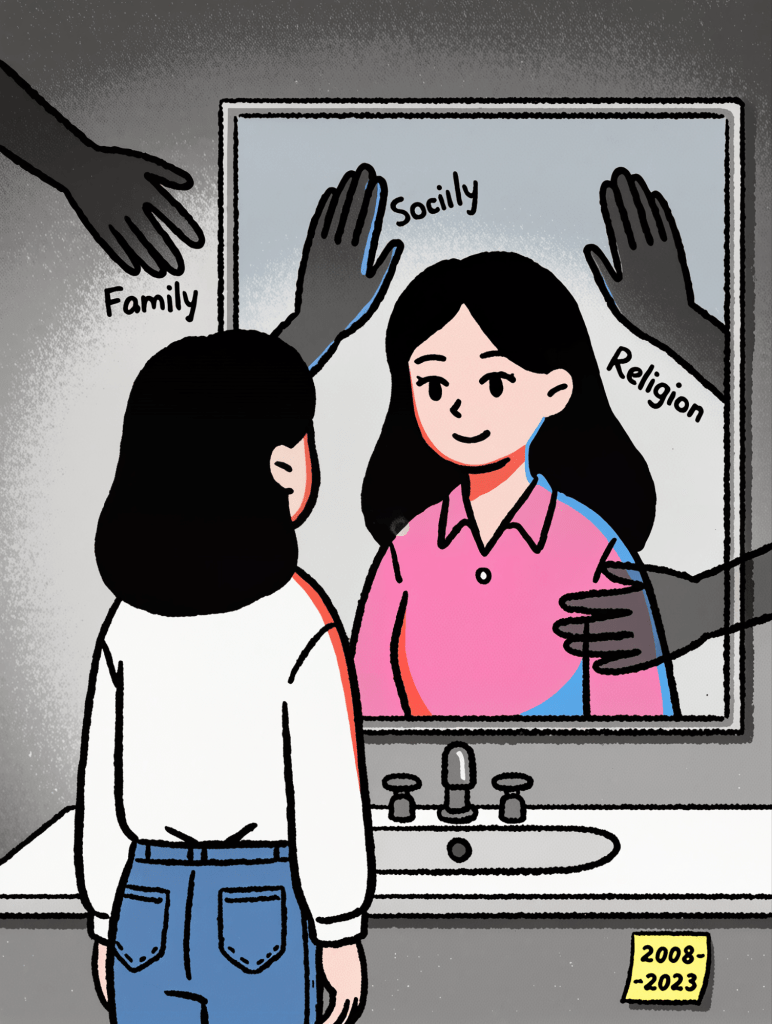
“It Gets Better” — I believe it is, in fact, a message from God.
Unlike most of the Middle East, I’ve read my holy book myself, and no — being trans is not a sin. There is no reason to believe we are cursed. I don’t accept the so-called hadiths falsely attributed to the Prophet. I will write an entire blog about my beliefs on this another time — but for now, let’s continue.
The message on the board is difficult to decode. Maybe those numbers are hinting at the “right” age for transitioning — maybe they imply that I should build the life I want by the time I’m 30. But that interpretation doesn’t quite fit. Because I’ve since learned that the 30–35 age range is not random at all — it’s based on real sociological research.
I asked ChatGPT for help, and here’s the explanation it gave me — which I’m now including in full so that you can understand it better:
> The commonly cited “30–35 years” life expectancy for trans women is not a random figure — it is the reflection of a painful truth and a symbol of systemic neglect. Studies conducted in Latin America have consistently shown that trans women face dramatically shortened life spans due to transphobic violence, healthcare discrimination, homelessness, and widespread social exclusion. A comprehensive 2015 report by RedLacTrans, titled “The Night is Another Country”, revealed that the average life expectancy for trans women in the region hovers around 35 years. Similarly, the Transrespect versus Transphobia Worldwide (TvT) project published a 2016 report titled “Violence against Trans People in Latin America”, highlighting how trans women — particularly in Brazil and Mexico — are frequently targeted and killed at a young age. Over time, these figures have been amplified by international human rights advocates and LGBTQ+ activists. The “30–35” statistic has evolved into more than just data; it has become a global alarm bell. It is not merely a number — it is a mirror held up to a world that has too often ignored the lives, struggles, and deaths of trans people.

As you can see, the part that speaks to me personally is still just this:
“It Gets Better — 2008–2023.” A message from the future. And I’m choosing to manifest that message.
The chaotic and nonsensical writing on the board reflects the flawed ideas we carry about the future — projections that are often meaningless, misleading, or outright false.
And with this post, I believe I’ve written my first manifestation blog.
I’ll be creating a new category just for this series, because I want to explore the idea of manifesting — and this cartoon was the perfect starting point.
Thank you for reading.
I’d eat you up. 💋


Leave a comment