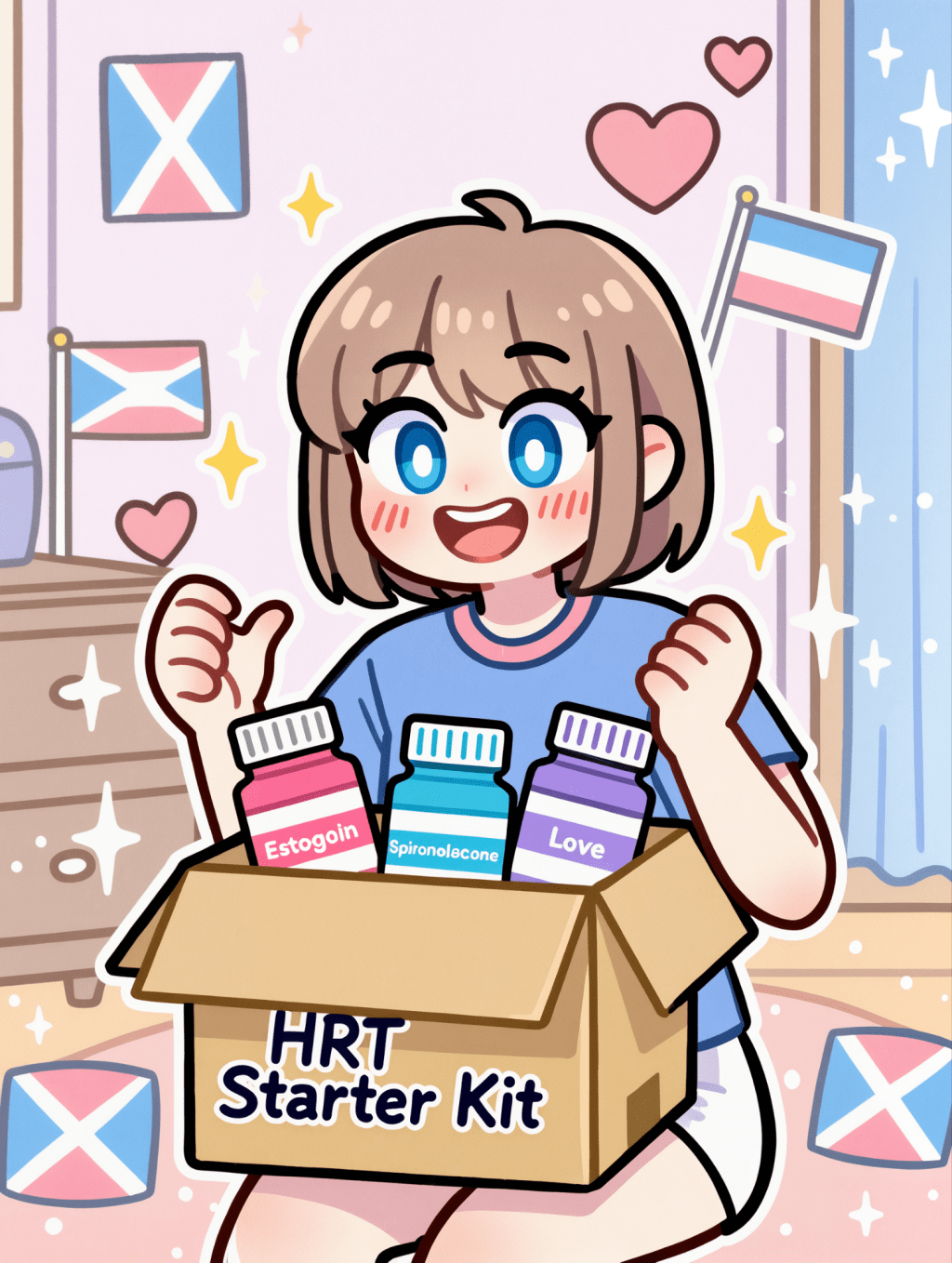
🌸 Manifesto – Part Two: Becoming a Woman

The medications mentioned in this article are provided for informational purposes only. No medication should be used without the recommendation of a doctor or qualified healthcare professional. Self-medicating can lead to serious health issues. Always consult your doctor regarding any health concerns.
First of all, deciding to start this journey is even harder than the transition itself, because it means leaving behind the version of life you’ve always known. From now on, you are choosing to become a woman—skirts, bras, dresses, blouses, makeup… These will become part of your daily life. Not only must you get used to them, but you should also learn to enjoy them.
Now that we’ve moved past the decision-making stage, it’s time to understand the process.
—
💊 The MtF Transition Is Based on 3 Types of Medication:
1. Testosterone Blockers
2. Estrogen Supplementation
3. Progesterone (Optional)
While progesterone is technically optional, many trans women report that it plays an important role in breast development, so I plan to include it in my regimen.
However, testosterone blockers and estrogen are absolutely essential—without them, the transition simply won’t work.
—
✨ Testosterone Blockers ✨
I’ve found several testosterone blockers, each with different effects. For example:
Spironolactone costs between $9 – $15/month. It’s safe, affordable, and one of the most commonly used anti-androgens in the U.S.
GnRH agonists (like Lucrin, Zoladex) range from $60 to $150/month. These are extremely powerful but also very expensive.
Finasteride / Dutasteride cost $6 – $12/month. They are considered supportive medications, especially for hair loss and body hair reduction. But are they really necessary?
Not all these medications are essential—some are considered optional or supportive.
—
🔍 What About Finasteride / Dutasteride?
These drugs block DHT (dihydrotestosterone), which helps reduce hair loss. They may slow the regrowth of body hair, but they have minimal effect on facial or existing hair.
They’re mostly used:
Alongside estrogen and anti-androgens,
By trans women struggling with male-pattern baldness,
In cases where testosterone levels remain high and additional DHT suppression is needed.
👉 They’re not for beard removal—they’re primarily used to slow scalp hair loss.
So, it’s very important to have guidance during this process. These medications are not something you should start based on a few Google searches. It’s essential to understand which medications are mandatory and which are optional.

—
🩵 Key Testosterone Blockers You Should Know
1. Spironolactone
Commonly prescribed in the U.S., Canada, and other trans-friendly healthcare systems.
Blocks testosterone at the cellular level.
Affects potassium balance—requires regular blood tests.
Has a mild diuretic effect.
Considered safe for long-term use and ideal for beginners.
—
2. GnRH Agonists (Leuprolide, Triptorelin, Goserelin)
Suppress testosterone production directly from the brain (pituitary gland).
Administered via injection (monthly or every 3 months) or as an implant.
Extremely effective, but very expensive—usually a last resort or for those with private insurance.
Considered the “gold standard” but not budget-friendly.
—
3. Cyproterone Acetate (CPA)
Most commonly used testosterone blocker in Europe (and Turkey).
Blocks testosterone production and its activity at the receptor level—dual action.
Strong effects—can accelerate breast growth.
⚠️ At high doses and with long-term use, it carries risks like liver damage, depression, and even meningioma (a rare brain tumor).
—
🧠 Final Thoughts
These are the most well-known and effective testosterone blockers used in the MtF process.
Which one you should use depends on your budget, location, and most importantly—your doctor’s guidance. Never self-medicate. Bloodwork, regular monitoring, and a trans-informed healthcare provider are non-negotiable on this journey.
—
🌸 Estrogen Supplementation – What You Should Know 🌸
As part of my research into estrogen supplementation, I’ve come across several medications, but before naming them, it’s essential to understand how they are used—because the method matters as much as the medicine.
Here’s a quick breakdown of the key methods and what they’re best known for:
💊 Economical → Oral Estradiol
🩸 Low blood clot risk → Patch / Gel / Sublingual
💉 Injectable (IM) → Faster feminization
🧠 Medically safest hierarchy → Patch > Gel > Injection
> ☝️ Remember: Choosing the right form is something you must decide together with your doctor.
(I’m sure you’ll do this 😄)

—
💉 My Personal Favorite Combo:
> Injection + Spironolactone → Strong and safe testosterone suppression + visible feminization 🩷💃
—
🥺 Now let’s talk about the most important part…
“Delestrogen” and “Progynon Depot” are among the most commonly recommended injectable estrogen medications.
Delestrogen is widely used in the United States and has a solid reputation.
But honestly, the most practical and accessible option is Progynon Depot—
It’s powerful, fast-acting, and promotes noticeable feminization.
I’ve also looked into the typical dosages these medications are used at, but since they can be dangerous without proper supervision, I won’t share that information here. ⚠️
Please consult a doctor or hormone specialist if you’re considering injectables.
—
💰 Cost Breakdown?
We’ll calculate that together at the end of this blog post 😊
But for now, let’s move on to Part 3 – the final and most essential section of the process…
—
🌙 Part 3 – Progesterone: What You Should Know 🌙
And the Final Cost of Transition
Before diving into medications, let’s start by understanding what progesterone does—specifically in cisgender women:
Supports breast development (especially nipple projection)
♡ Helps with emotional balance
♡ Improves sleep quality
♡ Enhances libido
These are well-documented effects in cis women.
But the real question is:
👉 Can transgender women experience the same results?
The simple answer is: yes.
There’s strong anecdotal evidence from the trans community that progesterone, when added around months 3 to 6 of transition—after starting estrogen and testosterone blockers—can enhance feminization.
Of course, this step should be taken with your doctor’s supervision. The risk of complications is very low, and most doctors will likely approve it if requested.
—
🌸 Benefits Reported by Trans Women:
♡ Many trans women report fuller breast development and improved shape
♡ A calmer emotional state and better sleep
♡ A sense of “balance” as part of the overall. hormone routine

—
⚠️ Critical Safety Note:
Progesterone is powerful. You must never self-medicate.
During my research, I came across several people who took synthetic or inappropriate forms without guidance—and suffered serious side effects.
So please: Always use it with medical approval.
—
💊 So, What’s the Most Recommended Progesterone?
That would be: Prometrium (micronized progesterone)
Based on trusted medical sources and community feedback:
It’s the most natural and well-tolerated option
Safe for breast development and emotional balance
Low blood clot risk compared to synthetic options
Taken orally or vaginally, usually at night before sleep
Helps reduce dizziness and improve nighttime calm
—
💰 And now… let’s talk about money. 💰
We’ll divide the cost of MtF transition into three categories:
1. 🟢 Economical Transition
2. 🟡 Recommended (Standard) Transition
3. 🔴 Surgical & Full Complex Transition
But before we break it down, here are some important reminders:
■ Costs can vary greatly by country, clinic, and personal choices
■ Surgeries may be more affordable in some countries, but they still carry high costs
■ Public insurance or state support can significantly affect your expenses
—
💡 Sample First-Year Scenario
(Medications + Doctor + Tests + Therapy)
Doctor visits: 4 x $200 = $800
Lab tests: 4 x $100 = $400
Hormone medications: 12 x $150 = $1,800
Psychotherapy: 10 x $100 = $1,000
Miscellaneous (syringes, travel): 12 x $30 = $360
Estimated Total: ~$4,360

—
📊 Summary of Total Cost Estimates
Level Estimated Yearly Cost (USD) Notes
🟢 Basic Medical Transition $2,000 – $5,000 Non-surgical, essential care only
🟡 Recommended Transition $4,000 – $7,000 Includes progesterone, therapy, etc.
🔴 Full Surgical Transition $10,000 – $30,000+ With breast augmentation, FFS, SRS
—
🧠 Final Thoughts
Maybe everything that needed to be said has now been said…
Now it’s time to reflect—and decide what’s right for you.

Leave a comment